


< back to articles
Richard Binzel, MIT professor at ISAE-SUPAERO
Published on
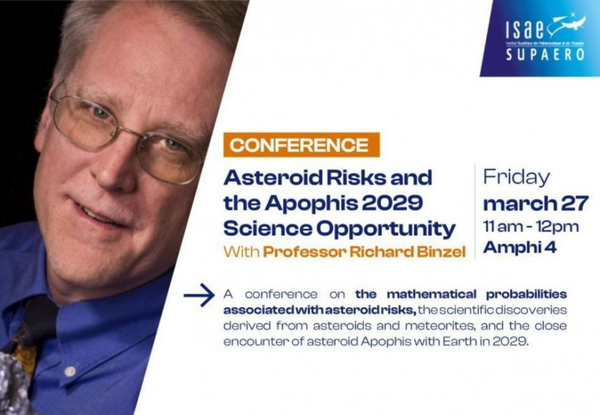
Hosted by Naomi Murdoch at ISAE-SUPAERO’s Department of Electronics, Optronics and Signals (DEOS), Richard Binzel, Professor of Planetary Sciences at the Massachusetts Institute of Technology (MIT), paid a scientific visit to Toulouse to discuss issues of planetary defense and asteroid seismology. On this occasion, he also gave a lecture open to the local scientific and academic community. He looks back on his visit.
A world specialist in asteroids and planetology
For over thirty years, Richard Binzel has devoted his research to understanding the physical structure of the solar system and its constituent planets. His work focuses in particular on asteroids, considered to be the “building blocks” involved in the formation of the Earth 4.6 billion years ago.
Through the study of meteorites and asteroids, he seeks to better understand theorigin of telluric planets such as Earth, Mars and Venus, as well as the conditions that led to the emergence of life.
His research has also led him to work on the risks associated with asteroid impacts with the Earth. Known for having developed the ” Torino Scale “, an international tool for communicating impact risks, Richard Binzel is now focusing on the internal characteristics of asteroids from a planetary defense perspective.
At the heart of this reflection is the asteroid Apophis, which will make an exceptionally close passage to Earth on April 13, 2029. This event represents a unique scientific opportunity to measure, for the first time, the seismic effects caused by terrestrial gravitational forces on an asteroid.
This is precisely the background to its collaboration with the SSPA teams at ISAE-SUPAERO, who are developing the SIA (Seismic Instrument for Asteroids) seismometer, destined to go on board ESA’s European Ramses mission.
A unifying conference on the Apophis 2029 mission
During his stay, Richard Binzel gave a lecture on March 27, 2026 to a large audience of students, researchers and institutional partners from ISAE-SUPAERO, CNES, ENAC and IRAP.
This presentation placed the work carried out at ISAE-SUPAERO in the international scientific context of research into Apophis and planetary defense. It also highlighted the technological challenges associated with measuring the seismic activity of an asteroid, a field still largely unexplored.
Richard Binzel highlighted the expertise of the ISAE-SUPAERO teams:
« Most impressive in the SSPA engineering team is the attention to detail to understand the underlying physics of the experiments, and the care and testing of new concepts for space engineering. »
An outstanding scientific and human collaboration
The visit also provided an opportunity to strengthen ties between ISAE-SUPAERO and MIT. Richard Binzel praised the quality of the welcome he received in Toulouse, as well as the academic level of the students and researchers he met.
For the American researcher, the visit opens up new prospects for scientific collaboration on future asteroid exploration missions and the development of space seismology. He is also impressed by Toulouse’s atmosphere, combining historical heritage with aeronautical and space excellence:
« Personally, I found the experience of all people at ISAE and throughout the city of Toulouse to be warm and inviting. Certainly inviting for a return. »

How did you use the funding you received?
This grant was mainly used to cover accommodation and daily expenses on site, as well as part of the travel costs associated with her stay in Europe. It was crucial for her to come here, as she had no other financial support.
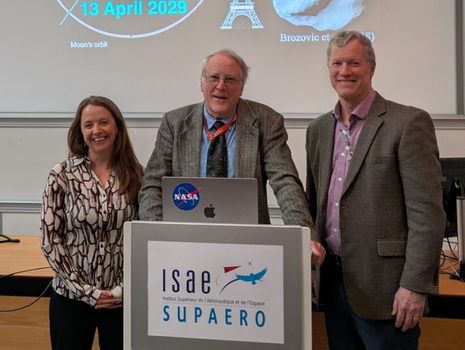
Professor Richard Binzel from MIT (center) alongside Dr. Naomi Murdoch of ISAE-SUPAERO (left) and Randolph Schweickart representing the Schwiekart Prize for Planetary Defense (right).
A word to the Foundation’s donors?
“It is with deep gratitude that I seize this opportunity for international exchange. I am convinced that it has been of great benefit to both parties, enabling the realization of major new projects in the field of space science. Thank you very much.”