


< back to articles
Louison at EVAN 2026: Her Research on Extreme Values
Published on
From July 21 to 23, 2026, 114 participants from around the world gathered in Delft, the Netherlands, for the 2026 edition of EVAN (International Conference on Advances in Extreme Value Analysis and Application to Natural Hazards). Louison Bocquet-Nouaille, a doctoral student with the MOIS (Modeling and Systems Engineering) team at ISAE-SUPAERO and ONERA, presented her research on extreme value statistics at the conference. She reflects on this international scientific experience.
What was your goal in participating in EVAN 2026?
As a doctoral student working on the development of applied statistical methodologies, my participation in the EVAN 2026 conference served several strategic objectives:
> Integration into the scientific community, through direct exchanges with international experts in extreme value theory, in order to become a full-fledged member of the leading research network relevant to my dissertation work;
> The dissemination of my research, by presenting recent methodological findings developed at ISAE-SUPAERO in collaboration with ONERA, in order to test their relevance and rigor before an audience of specialized peers;
> Methodological and practical openness by exploring potential use cases for our work.
What research was your presentation based on?
My research focuses on extreme value statistics, a discipline that is essential for modeling rare but critical events. While the applications presented at the conference focused on climate extremes and natural disasters, the general applicability of these statistical methods allows them to be adapted to other high-stakes fields.
During my doctoral research, I applied these approaches to specific aerospace problems, including:accuracy analysis of aircraft design models (cable mass ratio), characterization of extreme icing phenomena on wings (a critical cause of crashes), andassessment of the electromagnetic impact of lightning on onboard electronic equipment.
What conclusions do you draw from this conference?
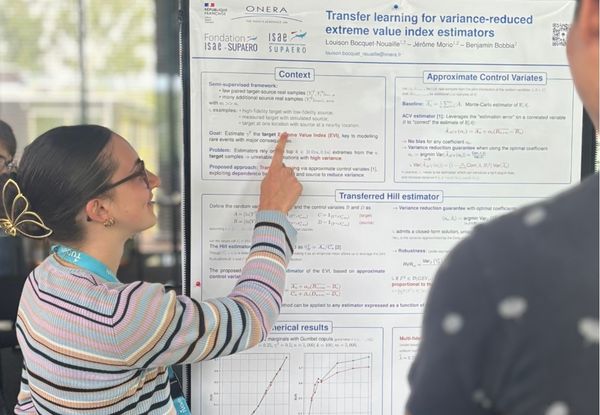
My participation in the EVAN conference was very rewarding: I was able to present our research findings in poster form to a community of experts, which led to stimulating discussions. The conference allowed me to discover many practical applications of extreme value theory in various fields (hydrology, meteorology, oceanography, climate, and geosciences), which broadened my understanding of the subject.
I have established valuable contacts with researchers from various international institutions. Coming from a background focused on statistical methods, my lack of in-depth knowledge in certain highly specialized fields (such as hydrology or oceanography) sometimes made it more difficult to understand certain presentations. Nevertheless, this has been an excellent learning opportunity to broaden my scientific knowledge.

How did this experience help you in your future career?
I have deepened my understanding of the diverse applications of extreme value theory, particularly as it relates to critical societal issues such as natural disaster preparedness and management. This has provided me with new perspectives for enhancing my methodological approaches. The networking opportunities allowed me to expand my professional network by connecting with other doctoral students and researchers in the field.
Exploring the campus and research ecosystem at TU Delft, a world-renowned university, gave me insight into how research is conducted in the Netherlands. This immersion has made me aware of the opportunities this country offers in my field and has encouraged me to consider it as a potential destination for a postdoctoral fellowship after I complete my dissertation.

A Message from Louison Bocquet-Nouaille to Donors
I would like to express my sincere gratitude to the Foundation for the financial support it provided, without which my participation in this event would not have been possible. The funding was used to cover certain logistical expenses related to this trip, specifically the round-trip travel to Delft and lodging.
Thank you very much for your support! Participating in international conferences is a fundamental part of my dissertation: it allows me to get feedback on my work from experts, enrich my research, and build my professional network.