


< back to articles
Alexandre: Best student paper at IAC 2025
Published on
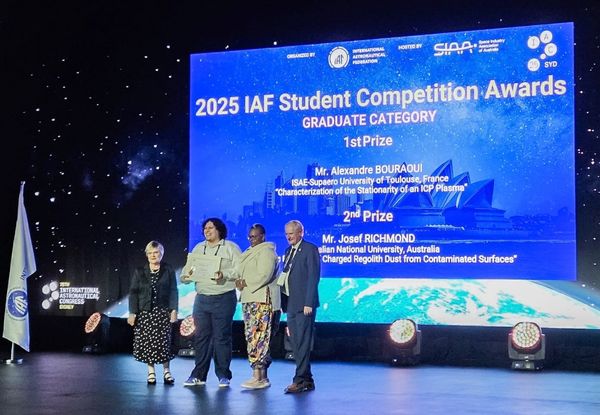
Taking part in an international conference can transform a career path. For Alexandre Bouraoui, a 3ᵉ year student at ISAE-SUPAERO in 2025, the experience of the 76th International Astronautical Congress (IAC 2025) in Sydney is proof of this. Thanks to a grant from the Fondation ISAE-SUPAERO, he presented his research and won the IAF Student Competition Award 2025 (Graduate Category). An experience that took him much further than he ever imagined: all the way to 2026.
What did theInternational Astronautical Congress mean to you and the space community?
When I learned of my selection by theAssociation Aéronautique et Astronautique de France (3AF) to represent France in the student competition at the 76th International Astronautical Congress, I immediately understood that this opportunity would go far beyond the academic sphere.
My initial goal was threefold. Firstly, I aspired to represent my country and my school, ISAE-SUPAERO, on the international astronautical stage. Secondly, I wanted to present the results of my DEOS research to an audience of world-renowned experts. Finally, and perhaps most importantly for my professional future, I wanted to take advantage of this unique experience to build a network in the international space industry, a sector I’ve always been passionate about and in which I’m currently an apprentice at Thales Alenia Space – when he writes his words – and where I want to build my career.
For me, the IAC was much more than just a conference. It’s an essential meeting place for the global space community, where future international collaborations take shape, where the major players in space exploration meet, and where young researchers like me can rub shoulders with scientists, engineers, space agencies and industry. Sydney, with its 7,000 participants from 99 different countries, provided an exceptional backdrop for my first major international experience.
What was the focus of your research presented at
International Astronautical Congress ?
My research work, carried out under the supervision of Romain Pascaud and Valentin Mazières within the PAMPA team, is part of a fundamental issue for the development of future space propulsion systems and their interaction with antennas. Inductively Coupled Plasma (ICP) is a promising technology for electric propulsion of satellites and space probes. Their principle is based on the heating of electrons by electromagnetic induction, without direct contact with the electrodes, which theoretically makes it possible to considerably extend the service life of space thrusters.
Theory predicts that these ICP plasmas should be perfectly stationary, i.e. exhibit constant properties over time. This stationarity is crucial to guaranteeing stable communications with earth if the antenna is close to the thruster feather, as may be the case on New Space satellites, which tend to miniaturize, or CubeSats in general. Our team therefore set out to verify this theoretical hypothesis experimentally, by setting up a characterization device to measure the plasma’s temporal parameters.
The results of our study revealed a more nuanced reality than theory would suggest. We observed that ICP plasma is not perfectly stationary. Periodic variations, albeit slight, appear in its characteristics. Even more interestingly, we were able to correlate these instationnarities with the feeding frequency of the plasma generation system. Although the time available for this study did not allow us to quantify precisely the amplitude of these variations, this discovery opens up new prospects for optimizing space propulsion systems and the electromagnetic compatibility studies that surround them.
For the aerospace sector, these results are of major interest. Firstly, in terms of EMC (electromagnetic compatibility) studies, as mentioned above, they provide a better understanding of the real limits of ICP plasmas, and enable us to anticipate their behavior under operational conditions. On the other hand, they suggest avenues of improvement for the control and regulation systems of these thrusters. Detailed characterization of these instationnarities could ultimately enable the development of active compensation strategies to maintain even more stable thrust, thus improving the efficiency and precision of orbital maneuvers on new-generation satellites.
Did this participation meet your objectives?
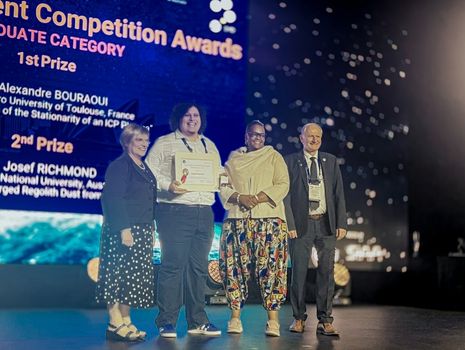
If I had to sum up my feelings in one word, I’d say that taking part in IAC 2025 far exceeded all the objectives I had set myself. Not only was I able to present my work in the prestigious student competition, but I also had the immense honor of winning the prize for best student paper in my category, which was the main category. Receiving this distinction in front of an audience of over 1,200 people at the closing ceremony will undoubtedly remain one of the most powerful emotions of my life. This moment crystallized months of hard work in the lab and validated our rigorous experimental approach.
Beyond this academic recognition, the networking aspect of the conference proved extraordinarily fruitful. I had the opportunity to exchange ideas with over a hundred participants from all over the world. These conversations were incredibly rich, touching on fields as varied as electric propulsion, Martian exploration, satellite constellations and new additive manufacturing technologies for space. I met engineers working for space agencies such as NASA, ESA and JAXA, researchers from prestigious laboratories, New Space entrepreneurs, and R&D managers from major industrial groups such as Thales Alenia Space and Airbus Defence and Space.
My presentation attracted a great deal of interest. Many participants came up to me after my session to discuss our results and methodology in more detail. Several asked for access to the full paper to deepen their understanding of our experimental approach. These exchanges were extremely enriching, with some experts suggesting further avenues of investigation or potential collaborations.
The technical sessions I attended were equally inspiring. I particularly enjoyed the presentations on new hybrid propulsion architectures, advances in reusable heat shields, and long-term lunar exploration projects. These sessions enabled me to contextualize my own research within the wider ecosystem of space innovation, and to understand how the different technological building blocks fit together to realize tomorrow’s missions.
The few negative points of this experience are minor compared to the benefits I gained. The time difference between France and Australia, with its 9-hour difference, did affect my physical fitness during the first few days. The jet-lag took some getting used to, and slightly reduced my concentration during the first few sessions. In addition, the intensity of the program, with technical sessions starting as early as 8:30 a.m. and often finishing after 6 p.m., followed by evening networking events, proved physically demanding. However, the adrenalin and excitement of discovering so many fascinating new things more than made up for any accumulated fatigue.

How did the scholarship support you?
The financial support of €800 granted to me by the ISAE-SUPAERO Foundation played a decisive role in making this project a reality. With the total cost of my participation estimated at €2,500, this funding covered two essential budget items. Firstly, it fully financed my accommodation in Sydney for the duration of the congress, i.e. €700 for a week in an Airbnb-type rental close to the congress center. Secondly, the remaining €100 contributed to the payment of part of the conference registration fees, which represented a substantial budget item. […]
Without this crucial funding, I would have had to pay the full €2,500 on my own, which would have represented a considerable financial burden for a student and potentially jeopardized my participation. The remainder of the budget was financed by my personal savings, covering in particular the Toulouse-Sydney-Toulouse plane ticket and the remainder of the registration fees. This substantial personal financial contribution testifies to my commitment and determination to seize this unique opportunity, but it also underlines how indispensable the Foundation’s support was in making this project a reality.
The impact of this participation
The impact of this participation on my career has far exceeded my initial expectations. In concrete terms, the experience has opened doors I never imagined I’d be able to open so quickly in my career. In the weeks following the congress, I was contacted by half a dozen international companies and research laboratories wishing to discuss my skills and career aspirations with me in greater detail. These contacts led to a dozen video-conference meetings with space program managers, research directors and R&D department managers.
Career opportunities
These discussions have led to a number of proposals, both in the field of research and in space engineering, whether as an apprentice payload architect at Thales Alenia Space, or for thesis opportunities in laboratories working on issues close to my interests in space propulsion. Others concern R&D engineering positions in companies developing tomorrow’s propulsion technologies, whether for satellite applications or planetary exploration. The diversity of these opportunities means that I can now envisage my professional future with a much clearer vision and options that match my aspirations.
The professional network
Over and above the direct professional opportunities, this participation enabled me to build up a solid international network in the space sector. The contacts made in Sydney are now a valuable resource for my future career. Whether it’s for advice, potential collaborations, or simply to keep abreast of the latest developments in the sector, this network represents invaluable relational capital. In particular, I’ve exchanged contact details with engineers working in space agencies such as NASA, ESA, CNES and JAXA, as well as companies like Rocket Lab, Lockheed Martin, Maia Space and innovative European New Space start-ups.
On a personal level
This experience also reinforced my confidence in my ability to evolve in such a demanding international environment. Presenting my work in English before an audience of experts, defending my methodological choices, and being able to discuss in depth with specialists proved to me that I had the technical and relational skills needed to succeed in this environment. The prize is also an external validation of the quality of my work, and a strong argument for my future applications, whether for a thesis or a company.
On the technical front
Last but not least, the technical sessions I attended introduced me to sub-fields of the space industry that I was unfamiliar with, and which were very interesting. I discovered fascinating issues I’d never thought about before, such as the technical sessions on the problems surrounding rendezvous in orbit, innovative methodological approaches during the MBSE sessions, and possible synergies between different astro fields in general, such as the plenary session on astro-archaeology in North America. This broader vision of the space sector is now helping me to refine my career plan and identify the complementary skills I want to develop in the coming years.
What are the prospects following this participation?
Taking part in IAC 2025 transformed my vision of my future career in space. It opened up a dozen or so concrete opportunities, ranging from thesis proposals in international laboratories to R&D positions in space companies in Australia and the U.A.E. The international network I built up with over a hundred professionals from all over the world is an invaluable network that today gives me a global vision of the space industry.
The prize validates the quality of my research, considerably reinforces my CV and allows SUPAERO to shine through my work. On a personal level, the experience reinforced my self-confidence and my ability to evolve in an international context. Finally, this immersion enabled me to identify precisely the areas I’m passionate about and the skills I want to develop, giving me a clearer vision of my professional project.
THE message from alexandre Bouraoui to donors
3rd year student
Dear donors,
I would like to thank you most sincerely for your generous support in enabling me to take part in the 76th International Astronautical Congress in Sydney. Your contribution was decisive in making this experience possible and literally changed my career path.
Thanks to you, I was able to present my research on ICP plasma characterization to the international space community and win the prize for best student paper in the main category. This recognition in front of 1200 people will remain one of the strongest emotions of my life. Beyond the prize, your support has enabled me to build a solid international network with over a hundred professionals from the space sector, a network that has already opened up a dozen concrete opportunities for the next stage of my career.
Your investment has had a considerable impact: you have invested in my future and contributed to ISAE-SUPAERO’s international reputation. Without you, this unique opportunity would have been out of my reach.
Thank you so much for your generosity.
From IAC to 2025
at Yale University in 2026
Alexandre Bouraoui’s participation in IAC 2025 is a perfect illustration of the tangible impact of the grants awarded by the Fondation ISAE-SUPAERO. By enabling him to present his work on the international stage, this support has contributed to the emergence of a young talent in space research, rewarded with a prestigious prize and integrated into a worldwide scientific network.
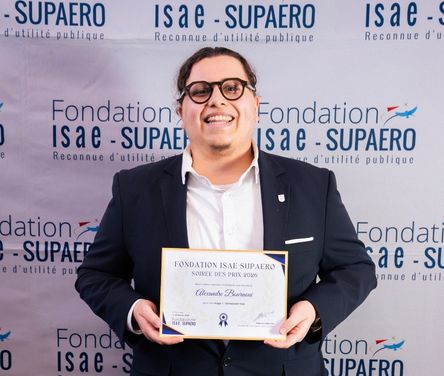
This momentum continued after the conference: thanks to the contacts made in Sydney and the visibility gained at the IAC, Alexandre landed a four-month research internship at Yale University. A new project made possible, once again, by the support of the Foundation, which awarded him a new scholarship this year, presented during the awards evening. A fine illustration of the multiplier effect of such support: nurturing today’s talent to nurture tomorrow’s scientific careers.
I want to support professional projects like Alexandre’s
Alexandre Bouraoui, 2026 Awards Evening