


< back to articles
Networking at CNES: The IEEE Student Branch at the Heart of the Space Industry
Published on
On June 11, 2026, the IEEE ISAE-SUPAERO Student Branch organized a networking event on the sidelines of the Detector Working Group meeting hosted by CNES in Toulouse. The event gave 30 students the opportunity to explore CNES’s testing facilities and network with 40 professionals from the space industry. Valentin BARIL, a doctoral student at ISAE-SUPAERO and the project’s organizer, reflects on the event.
What is the IEEE ISAE-SUPAERO Student Branch?
Founded in 2017, the IEEE ISAE-SUPAERO Student Branch is a student chapter of the Institute of Electrical and Electronics Engineers ( IEEE), an association based at the DEOS laboratory at ISAE-SUPAERO.
The mission of the ISAE-SUPAERO student branch is to promote exchanges between the academic world and the professional sector in the fields ofaerospace and image sensors.
How did the idea for this networking event come about?
The initial concept for the project was to organize a networking event on the sidelines of the Detector Working Group meeting hosted by CNES on June 11, 2026, in Toulouse. This workshop brought together experts from space agencies (CNES and ESA) and their industrial partners (Airbus Defence & Space, Thales Alenia Space, Alter, Pixalys, etc.) and academic partners (CEA-Leti, CEA-Irfu, ISAE-SUPAERO, etc.) to discuss advances in space detection and optoelectronics.
The idea was to take advantage of these experts’ visit to Toulouse to offer ISAE-SUPAERO students an immersive experience in space innovation, while creating opportunities for them to meet andinteract with professionals in the field.
Several objectives had been set: to introduce students to CNES’s technical resources ( test benches, sensors, neuromorphic cameras, etc.), to facilitate discussions among students, doctoral candidates, and professionals regarding career paths, thesis topics, and career opportunities; to enhance ISAE-SUPAERO’s reputation in the fields of space and electronic engineering; and to inspire interest in research and the space industry by showcasing the diversity of professions and applications.

How did the event go?
The event was divided into two parts: first, a guided tour of the CNES laboratories led by ISAE-SUPAERO/CNES doctoral students, followed by a cocktail reception for students and professionals.
During the guided tour, 30 students ( including ISAE-SUPAERO doctoral students co-supervised by CNES) were able to explore the testing facilities of the Optoelectronic Detection Department, notably the SWIR (Short Wave Infrared) and FTIR test benches for infrared detectors, event-based cameras (neuromorphic, motion-based), and test benches for evaluating the effects of lasers on detectors.
The tours were led by three doctoral students from ISAE-SUPAERO and CNES: Eva Filliodeau, on the effects of lasers on detectors; David Peninon-Herbaud, on event-based cameras for space applications; and Julie Grosjean, on the effects of radiation on infrared space detectors. The students also attended a general presentation on CNES and its activities in imaging and detection in the visible, infrared, and X-ray spectrums.
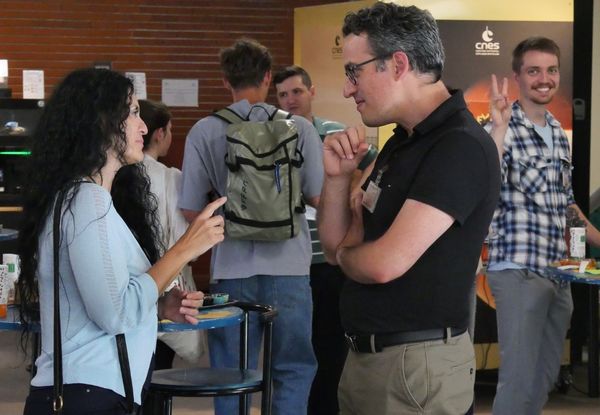
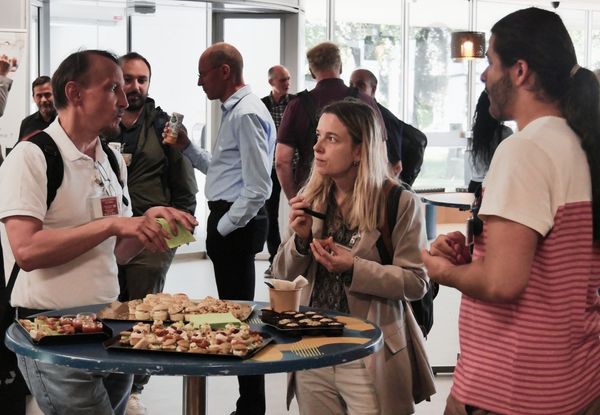
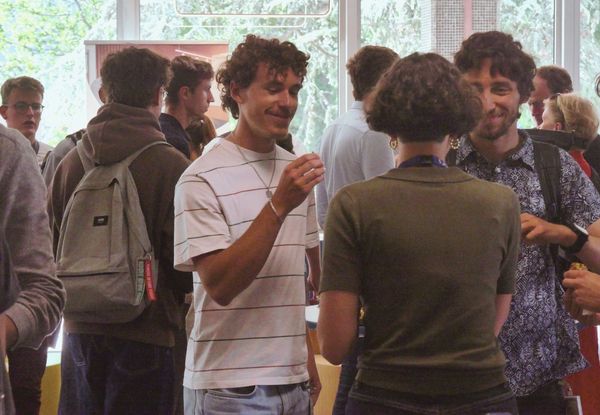
The tour was followed by a networking cocktail reception. Seventy participants ( 30 students and 40 professionals) had the opportunity to mingle informally for over two hours. The students spoke with experts from ESA, CNES, Airbus DS, Thales Alenia Space, Leonardo UK, Alter Technologies, CEA-IRFU, and the Open University. Two other doctoral students then joined the event: Asnate Plocina ( ISAE-SUPAERO/Airbus DS/Teledyne e2v) and myself, Valentin Badefort-Baril ( ISAE-SUPAERO/ESA-ESTEC/Airbus DS).
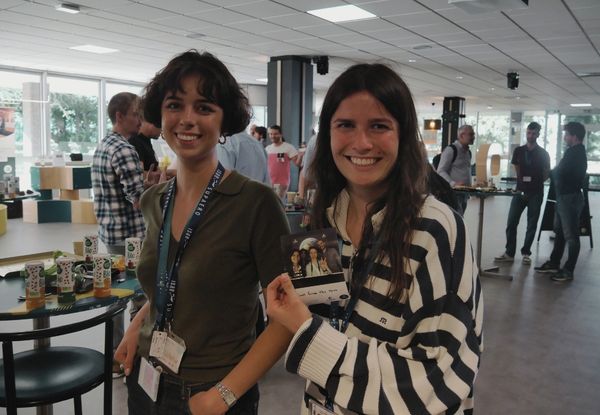
A photo booth featuring the CASPEX cameras on the Rashid rover—the result of a collaboration with the United Arab Emirates—also allowed participants to take home a souvenir, strengthening the group’s bond.
What was the main feedback from the participants?
With regard to the objectives mentioned earlier, we believethey were met and even exceeded. The students were introduced to cutting-edge technologies and were able to ask technical questions directly to the experts. They greatly appreciated their special access to CNES’s space imaging technologies.
The cocktail reception also broke down barriers between different groups, facilitating discussions about career paths, thesis topics, and career opportunities. Feedback from students indicates a high level of satisfaction: “A great tour of the labs followed by some very interesting discussions!”; “I learned about methods like stacking for space components—it was really inspiring!”
But the event’s appeal wasn’t limited to students. Many professionals appreciated this student-professional research format, which they felt was far too rare. We agree with this assessment.
What conclusions do you draw from this experience?
For the association, the event gave students the opportunity to broaden their perspective on careers in the space industry and to explore options for their future paths ( thesis, industry, research).
Several key takeaways emerge from this experience:
- Smooth organization: The logistics (tours, cocktail reception, photo booth) were perfectly orchestrated, thanks to effective collaboration between the IEEE ISAE-SUPAERO Student Branch, CNES, and the ISAE-SUPAERO Foundation. The dual status of ISAE-SUPAERO/CNES doctoral students is a real asset for facilitating the organization of events at CNES.
- Event Format: The hybrid format (tours + networking) allowed for a combination of technical learning and informal interactions, which was greatly appreciated by the participants.
- Diversity of participants: The event brought together students, doctoral candidates, researchers, and industry professionals, creating a dynamic network focused on the challenges of space-based detection.
- Finally, the outcomes were particularly positive. Professionals emphasized the importance of this type of initiative in inspiring career choices and preparing the next generation of engineers and researchers. They also highlighted the importance of the social aspect of this type of event. The excellent feedback and the enthusiastic response from the professional community exceeded our expectations.
The main weakness identified relates to the number of participants. Due to restrictions imposed by CNES, we cannot accommodate more than 30 students. However, we cannot influence this matter. The solution is to make these types of events a regular feature so that as many students as possible can benefit from them at least once during their studies.
Looking ahead, the IEEE ISAE-SUPAERO Student Branch hopes to continue its activities: We plan to resume our conference activities at the start of the new academic year. Following the very positive feedback from both students and professionals, the association also plans to organize another event of this type in 2027 for the RTS and/or IRSA workshops.
How did support from donors at
contribute to the project?
The funding provided by the ISAE-SUPAERO Foundation was used in its entirety to organize the networking cocktail reception. The Foundation’s contribution thus accounted for 50 percent of the total financial support, with additional funding provided by ISAE-SUPAERO’s DEOS department.
This funding made it possible to create a welcoming environment conducive to interaction, while keeping costs low for participants, as the event was free for everyone.
“Thank you for your support; you’re making it possible for students to have a unique experience.” — V. Baril